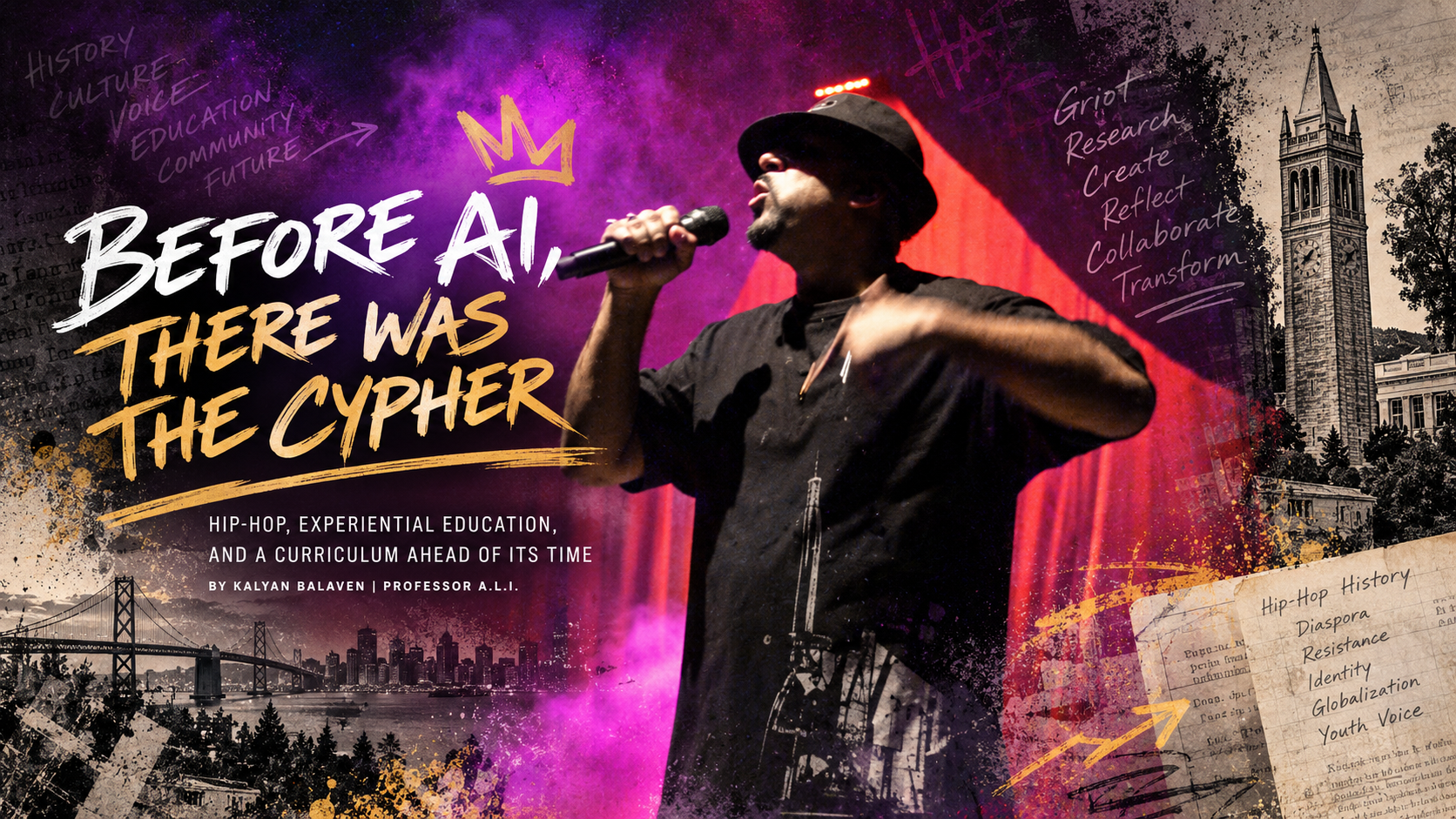
Nearly fifteen years after developing a pioneering UC-approved Hip-Hop history course, Professor A.L.I. reflects on the scholars, artists, and students who shaped it—and why its lessons about cultural competence, student-centered learning, and authentic humanity matter even more in the age of artificial intelligence.
By Kalyan Balaven | Professor A.L.I.
The Cypher Comes Full Circle
A few weeks ago, I found myself in a conversation that began as a brainstorm but quickly became something else. Ideas were being exchanged, challenged, sampled, remixed, and returned with greater depth. There was no predetermined destination, no singular voice controlling the narrative, and certainly no shortage of intellectual improvisation.
In Hip-Hop, we have a word for this.
A cypher.
And somewhere in that exchange, I found myself returning to a question I had been exploring nearly fifteen years earlier: What happens when we stop asking students to enter our world of learning and instead build learning experiences that begin in theirs?
Back in 2013, I created a course called Beats, Rhymes & Life: An Exploration of Hip-Hop, Its History and Global Impact for the Bay Area BlendEd Consortium, an innovative collaboration among independent schools experimenting with what education might become when learning transcended the physical classroom.
The curriculum had been percolating for years, emerging from units I had experimented with during summers working with students through UC Berkeley’s Early Academic Outreach Program (EAOP). There, I was exploring how the language, music, and cultural experiences students already possessed might become entry points into historical inquiry.
By 2013, those ideas had matured into something much larger: what I understand to have been the first University of California A–G-approved high school history course dedicated to Hip-Hop, a blended learning experience, an exploration of the Bay Area as a living classroom, and an experiment in the intersection of cultural competence and experiential education.
My daughter, Husna, was four years old.
Today, she is seventeen, completing college applications and imagining the next chapter of her own education.
Time flies.
But the curriculum? The curriculum kept spinning.
And like any good record, sometimes you have to return to the original pressing to appreciate what was in the grooves.
Hip-Hop Was Never Just the Subject
The first misconception worth addressing is that this was a class about music.
Nah.
Music was the medium.
History was the discipline.
Humanity was the subject.
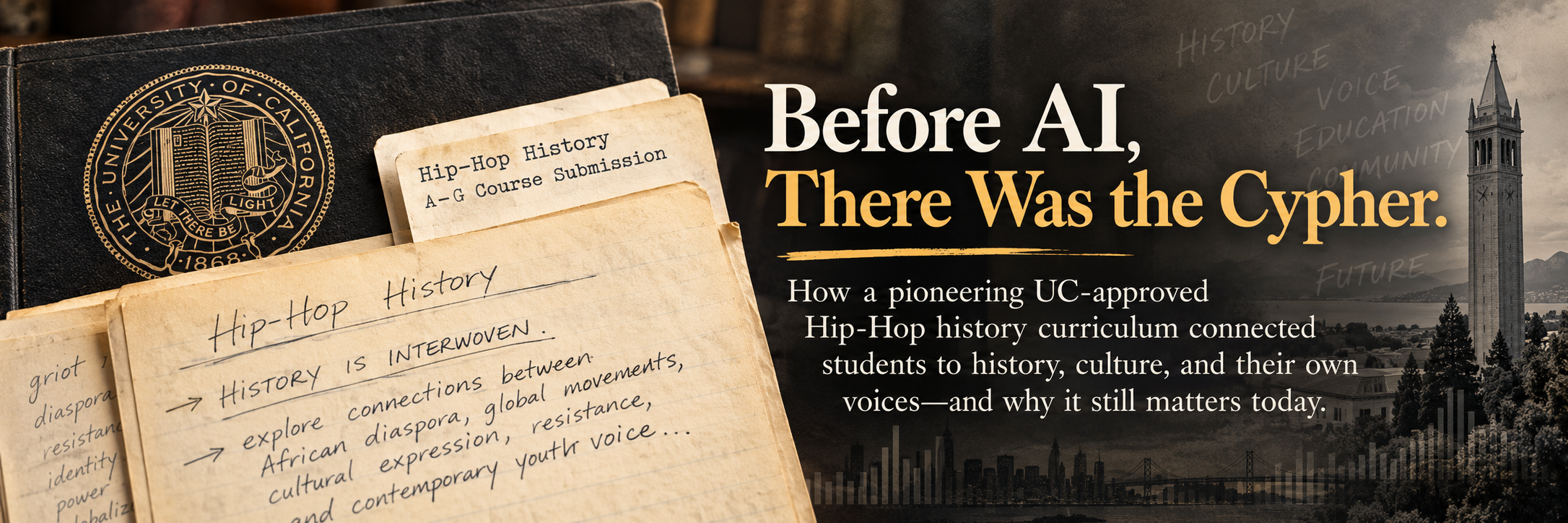
I recently returned to the original course submission I prepared for the University of California’s A–G approval process. Reading it more than a decade later, I was struck by how clearly the pedagogical philosophy had already taken shape.
I wrote that the purpose of the course was to help students understand that “history is interwoven.”
That was the intellectual proposition.
The curriculum was not asking students merely to identify Hip-Hop’s origins or memorize its pioneers. It was asking them to investigate the historical conditions that made a cultural movement possible, examine competing interpretations of those conditions, and consider how artistic expression might carry histories that conventional institutions had marginalized.
The original UC submission described Hip-Hop as a countercultural movement through which historically marginalized voices could assert themselves. It traced connections among the African diaspora, the transatlantic slave trade, the Harlem Renaissance, jazz, spoken word, Black intellectual traditions, political movements, and globalization.
Students encountered W. E. B. Du Bois, Booker T. Washington, Marcus Garvey, Malcolm X, and the Black Panther Party alongside Gil Scott-Heron, the Last Poets, Tupac Shakur, KRS-One, and Chuck D.
We examined the political consciousness of the Bay Area, the relationship between geography and artistic expression, and the ways Hip-Hop could serve as a vehicle for resistance from Oakland to Palestine, Chiapas, and Tamil diasporic communities in Toronto.
We considered the roles of women and LGBTQ artists, cultural appropriation, misogyny, commercialization, authenticity, and the tensions between art as resistance and art as commodity.
These were not easy conversations.
Nor were they intended to be.
The course demanded that students examine competing interpretations, interrogate historical narratives, and develop arguments grounded in evidence.
One of its central propositions was that history is interwoven. Events separated by centuries and continents can contribute to cultural forms that emerge much later, often in ways that are contested, unexpected, or difficult to trace.
My own exploration of the oral traditions surrounding Zaynab of Karbala, West African griots, and the historical transmission of poetic expression offered students an opportunity to examine how narratives travel. These connections were presented as interpretive inquiries, inviting students to distinguish historical evidence from cultural resonance.
That distinction matters. Good history does not simply produce an appealing origin story. It asks what we can establish, what we can reasonably infer, and what remains open to interpretation.
KRS-One’s characterization of Hip-Hop as intelligent movement became an organizing idea for the course.
Knowledge was not something to possess passively. It was something to move with.
And movement, in this context, was intellectual, cultural, physical, and spiritual.
The students were not simply studying Hip-Hop.
They were being asked to think like historians through Hip-Hop.
Building a Curriculum Through a Community of Thinkers
No meaningful educational innovation emerges in isolation.
As I developed the course, conversations with friends and fellow thinkers helped sharpen both its intellectual ambitions and its pedagogical possibilities.
Dr. Mark Anthony Neal, the James B. Duke Distinguished Professor of African and African American Studies at Duke University, had long been a leading voice in the study of Black popular culture, masculinity, and Hip-Hop. His scholarship helped establish the legitimacy of popular culture as a serious site of intellectual inquiry.
Adisa Banjoko, known as the Bishop of Hip-Hop and founder of the Hip-Hop Chess Federation, was advancing an equally important argument through practice: the cultural fluency students brought to learning could become a bridge toward strategic thinking, discipline, and intellectual development.
Bakari Kitwana, author of The Hip Hop Generation and a pioneering voice in Hip-Hop journalism and cultural criticism, offered another perspective on the relationship between youth culture, political consciousness, and the responsibilities of those interpreting the movement.
And Dr. Tariq al-Jamil, an associate professor of religion at Swarthmore College and scholar of medieval Islamic history, brought another dimension to my thinking. His scholarship on Shi’i–Sunni relations, religious identity, and the transmission of knowledge in Islamic societies offered an important intellectual lens through which to consider how histories are preserved, contested, and carried across generations.
Our conversations helped me think more deeply about the historical narratives that connected Karbala, the Islamic world, and the oral traditions I was examining as part of the course. This was particularly meaningful because I wanted students to recognize that the history of Hip-Hop could invite inquiry into centuries of cultural and intellectual exchange, without reducing that complex history to a single, uncontested lineage.
In separate conversations, Neal, al-Jamil, and Kitwana challenged me to consider whether the curriculum I was imagining might be ahead of the educational institutions being asked to embrace it.
I remember those exchanges not as predictions of some inevitable future, but as invitations to push further.
What would it mean to treat Hip-Hop not as an occasional classroom engagement strategy, but as a legitimate intellectual framework?
What would happen if the cultural knowledge students possessed became an asset rather than something to be set aside before academic learning could begin?
And could a curriculum built around a cultural movement preserve its authenticity once translated into institutional requirements, grading rubrics, and university approval?
Those questions were consequential.
They remain so.
Dr. Cris Cullinan, an educator whose understanding of experiential learning helped me recognize the possibilities of the model, saw something important in the approach early on: the intersection of lived experience, cultural competence, and rigorous academic inquiry.
We often talk about experiential education as though experience requires a mountain, a wilderness expedition, or a laboratory.
But experience also resides in culture.
It resides in language.
It resides in the music that accompanies a young person through adolescence, the neighborhoods they inhabit, the identities they negotiate, and the stories they inherit.
A culturally competent experiential educator must be willing to recognize those experiences as legitimate sources of inquiry.
The question is not whether students arrive with knowledge.
They do.
The question is whether we know how to teach from it.
An Intellectual History Written in Rhythm
The breadth of the curriculum was intentional.
Students were introduced to KRS-One’s understanding of Hip-Hop as intelligent movement and asked to compare it with the cultural definitions advanced by Yasiin Bey and Talib Kweli. They explored the political consciousness of Chuck D and Public Enemy alongside the poetic interventions of Gil Scott-Heron and the Last Poets.
They encountered the intellectual legacies of W. E. B. Du Bois and Booker T. Washington, the revolutionary ideas of Malcolm X, the activism of the Black Panther Party, and the artistic contributions of Assata Shakur’s generation. The Bay Area provided another layer of inquiry through Tupac Shakur, Paris, the Conscious Daughters, and the political history of Oakland.
But the curriculum was never confined to the United States.
Students examined the Zapatista movement in Chiapas, Palestinian cultural expression, Tamil diasporic communities in Toronto, and the globalization of Hip-Hop as a language of political agency. They considered the contributions of women and LGBTQ artists, while interrogating misogyny, homophobia, commercialization, and cultural appropriation within the movement itself.
The reading and listening were deliberately demanding. Students encountered C. L. R. James’s The Black Jacobins, historical scholarship on the African diaspora, and critical examinations of race, power, and popular culture.
Hip-Hop was the doorway.
Beyond it stood an entire world of history, philosophy, political theory, literature, and cultural criticism.
And students were invited to enter, not as passive consumers of knowledge, but as participants in its creation.
The Bay Area Was Our Textbook
One of the most radical elements of the course was its structure.
Students enrolled from different independent schools across the Bay Area, engaging in a combination of online learning, collaborative discussion, independent inquiry, and carefully designed face-to-face experiences.
Long before the pandemic made hybrid learning a universal concern, the BlendEd Consortium was examining how technology could expand the boundaries of the classroom without sacrificing the relationships at the center of education.
But the technology was never the point.
It was the infrastructure.
The Bay Area became our classroom.
The original syllabus envisioned learning experiences at UC Berkeley, visits to recording studios, encounters with Hip-Hop artists, and opportunities to engage with the region’s rich history of political and cultural activism.
Students researched issues connected to Oakland, including the legacy of Oscar Grant, police brutality, community activism, and the relationship between cultural expression and social movements.
They were asked to move beyond the textbook, encounter the world, and return with something to say.
This was experiential education operating through what educational theorist David Kolb described as a cycle of learning: concrete experience, reflective observation, abstract conceptualization, and active experimentation.
Students encountered cultural artifacts and places. They reflected on their meaning. They developed historical interpretations. Then they tested those interpretations through creative production and dialogue.
And importantly, they did not all arrive at the same conclusions.
That was the point.
The classroom was not a place where the teacher’s interpretation became the final verse.
It was a place where students learned to construct their own and defend them.
The XFactor: When the Textbook Became an Album
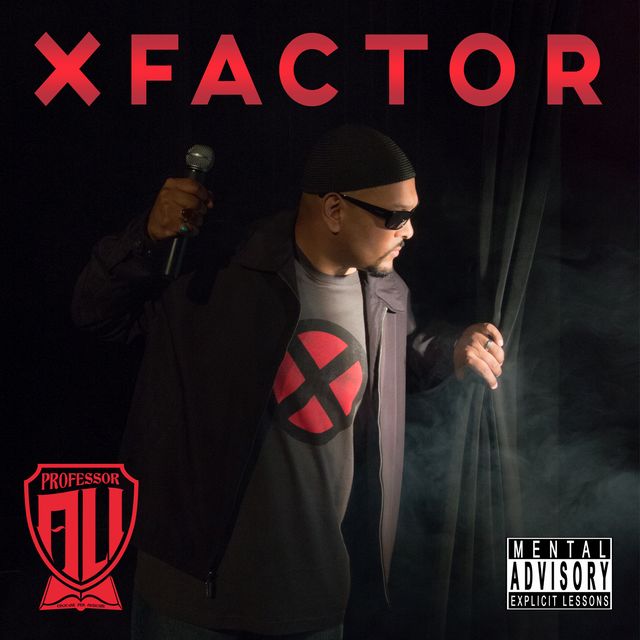
Perhaps the most unconventional element of the course was the integration of XFactor, an album I developed as Professor A.L.I. that functioned as an audio curriculum.
Songs were not simply entertainment placed between readings.
They were texts to be studied, questioned, compared, and challenged.
Students listened to tracks such as The Inception, 4 Elements of the Hip-Hopalypse, An Ode to Zaynab, Karavan from Karbala, and Diasporal Histories, moving between lyrical analysis and historical sources.
The album allowed me to approach the curriculum as both educator and artist, translating historical ideas into a form that students could revisit through rhythm, narrative, and sound.
But the album was not intended to replace scholarship.
It was meant to provoke it.
Students were expected to read, research, and test the arguments embedded in the music.
In one assignment, they compared different musical interpretations of Zaynab’s story. In another, they traced historical narratives geographically. Elsewhere, they examined competing definitions of Hip-Hop or analyzed how artistic expression reflected political consciousness.
They wrote research papers using Chicago-style citations, participated in discussions, and completed document-based assessments.
Then they became creators.
Students produced digitally recorded audio essays, developed multimedia presentations, and transformed research into artistic expression.
An argumentative essay could become a verse.
A historical interpretation could become a recording.
A scholarly critique could become a cypher.
In educational language, we might describe this as multimodal assessment, interdisciplinary learning, or authentic demonstration of understanding.
In Hip-Hop?
We called it dropping knowledge.
The distinction matters because the creative work did not eliminate academic rigor. It demanded that students understand their subject well enough to translate it into another medium.
And translation is among the most demanding forms of intellectual work.
You cannot meaningfully remix what you do not understand.
When the Research Paper Found Its Rhythm
Listening back to the music my students created, I hear something that no transcript, gradebook, or course evaluation could ever fully capture.
I hear their voices.
Not mine.
Theirs.
After weeks of reading, research, historical analysis, and argumentation, students were challenged to take what they had learned and transform it into something of their own. Their research papers had required them to develop a thesis, interrogate evidence, and defend an interpretation of history. Their final creative projects demanded something different, perhaps something more difficult.
They had to put their voices to beats.
And when I listen back to those recordings, I hear young people doing what Hip-Hop has always invited its practitioners to do: make meaning from the world around them.
Some approached the assignment through political commentary. Others through personal narrative, historical interpretation, or lyrical experimentation. What mattered was not whether they sounded like professional emcees. It was whether they could translate intellectual understanding into authentic expression.
Consider the cognitive journey involved. A student might begin by studying the African diaspora, examine the relationship between the Harlem Renaissance and Hip-Hop, interrogate the political consciousness of Chuck D or KRS-One, construct a historical argument in a research paper, and then reimagine that argument through rhythm, metaphor, and verse.
The medium changed.
The intellectual work did not disappear.
It deepened.
This is something educators sometimes miss when we discuss student-centered learning or culturally responsive pedagogy. Meeting students where they are does not mean leaving them there. It means recognizing where they begin and building a pathway toward intellectual places they might never have imagined reaching.
The music became evidence of learning, certainly. But it also became evidence of ownership.
And ownership is different from compliance.
A student can complete an assignment because a teacher requires it. A student who finds something worth saying, and develops the courage to say it in their own voice, has crossed a different threshold.
Some of those students have since become educators themselves. I wonder whether they remember the details of the historical arguments they made, or the grades they received. I suspect some remember the moment they first heard their own recorded voices, carrying ideas that had once belonged to a textbook, a historian, or a classroom discussion.
I certainly do. One of the final assignments had the class respond to the song The Mic Shall Inherit the Earth by Professor A.L.I. featuring Blitz the Ambassador (Blitz Bazawule), which is about the idea that Hip-Hop is now a global phenomenon, where shared voice is invited, provided that it acknowledges the DNA strands that allow that voice to be a part of the voices that came before. The following is the first cohort of students responding together in the studio over the same instrumental, a testament to their journey and to what they learned:
There is something profoundly moving about returning to these recordings more than a decade later. The technology sounds dated. The production varies. The young voices belong to people who have since grown into adulthood.
But the humanity remains.
A research paper demonstrated what they knew.
A verse revealed what they had made of that knowledge.
And perhaps that is what education should aspire to accomplish: not simply the transmission of understanding, but its transformation into something a learner can carry into the world.
It was the emergence of the storyteller.
The cypher had made room for another griot.
When Innovation Outlives Its Innovator—and When It Doesn’t
One of the most important questions facing independent schools is whether the innovations they celebrate can survive the departure of the people who created them.
As my responsibilities at The Athenian School evolved, I eventually stepped away from teaching Beats, Rhymes & Life. By then, the course had become part of the BlendEd Consortium’s offerings, with a formal curriculum, university approval, assessments, and a pedagogical structure that other educators could adopt.
Ras Ceylon, the Sri Lankan American Hip-Hop artist, educator, and activist, carried the work forward, bringing his own experience, artistry, and cultural consciousness into the classroom.
I was proud of that evolution.
A curriculum rooted in the traditions of the griot should never depend upon a single storyteller. Its intellectual foundations should be strong enough to sustain reinterpretation, new voices, and new generations of students.
Yet there is a bittersweet dimension to this history.
Although the course had been institutionalized through the BlendEd Consortium, The Athenian School eventually stopped offering it.
That remains a disappointment.
Not because every course should exist forever, nor because innovation deserves preservation simply for having once been innovative. Schools must make difficult curricular decisions, and educational programs should evolve with the needs of students.
But there is something worth examining when a course designed to expand the boundaries of conventional education disappears from the offerings of an institution committed to experiential learning.
What determines which innovations endure?
Is it student demand? Institutional priorities? The availability of faculty? The vision of leadership? Or our collective willingness to recognize cultural knowledge as academically worthy?
I do not raise these questions to diminish the work of the educators who continued teaching the course, or the institution that first made it possible. Indeed, Athenian and the BlendEd Consortium created the conditions for an experiment that might not have found a home elsewhere.
But the discontinuation offers a reminder that educational innovation requires more than a visionary beginning.
It requires institutional stewardship.
It requires the willingness to protect intellectual experimentation after its novelty has faded.
And it requires recognizing that some of the most important courses are not necessarily those that fit neatly into inherited disciplinary categories.
The irony is not lost on me.
As schools now race to imagine interdisciplinary learning, culturally responsive pedagogy, creative assessments, and authentic student engagement in the age of artificial intelligence, I find myself looking back at a course that brought those ideas together more than a decade ago.
The course may have left the catalog.
Its questions have not left education.
Perhaps it is time to bring the cypher back.
When the World Finally Went Blended
Then came 2020.
Almost overnight, schools across the world were forced to reconsider assumptions about where teaching happened, how students learned, and what it meant to maintain a community when people could no longer gather physically.
For schools participating in the Bay Area BlendEd Consortium, the underlying ideas were not entirely unfamiliar.
Educators had already been experimenting with asynchronous learning, digital discussion, independent student work, and intentional face-to-face encounters.
At Athenian, that prior experience contributed to an institutional foundation for the rapid transition to remote and hybrid learning.
It did not make the pandemic easy.
Nothing could.
But there is a meaningful difference between encountering a pedagogical model for the first time during a crisis and having years of experience exploring its possibilities and limitations.
The lesson was not that technology could replace the classroom.
It was that thoughtful educational design could preserve continuity across changing circumstances.
And perhaps more importantly, the experience reinforced something I had come to believe long before COVID-19.
The future of education would not be determined simply by the tools we adopted.
It would be determined by the humanity we preserved while adopting them.
Authentic Humanity in an Artificial World
Today, artificial intelligence has placed another technological revolution at the doorstep of education.
Students can generate music, produce videos, create visual art, synthesize historical documents, and construct arguments with tools that would have seemed extraordinary in 2013.
An assignment that once required access to a recording studio can now be attempted on a laptop or phone.
A student can create a beat, generate a voice, and produce a polished multimedia artifact in minutes.
The possibilities are extraordinary.
So are the questions.
If artificial intelligence can generate the verse, what does it mean to be an emcee?
If a machine can summarize the historical narrative, what does it mean to be a historian?
If an algorithm can reproduce the sound of a culture, can it understand the experience from which that culture emerged?
These questions return me to the griot.
The West African griot is more than a transmitter of information. The griot carries memory through relationship, performance, and communal responsibility.
The story matters.
But so does the storyteller.
The cypher offers a similarly powerful educational metaphor.
A cypher is not simply a collection of individuals producing content. It is a relational space in which participants listen, respond, improvise, challenge, and contribute.
One person’s expression becomes another person’s invitation.
Knowledge emerges through interaction.
And while artificial intelligence may help students access information, experiment with form, or extend their creative possibilities, it cannot assume the human responsibility of belonging to a community and being accountable to others within it.
This is where the old curriculum feels unexpectedly contemporary.
The most important thing about our students’ audio essays was never the recording technology.
It was the process of deciding what they believed, researching why they believed it, finding the courage to express it, and making themselves vulnerable to the interpretations of others.
AI can accelerate production.
It cannot make that human journey unnecessary.
In fact, it makes the journey more important.
The Kolb Cycle, the Cypher, and the Future of Learning
I have increasingly come to understand the relationship between experiential education and artificial intelligence through Kolb’s experiential learning cycle.
In its simplest form, learning moves through experience, reflection, conceptualization, and experimentation.
The Hip-Hop curriculum embodied that movement.
Students encountered music, history, artists, communities, and places. They reflected on those experiences. They developed interpretations. They tested those interpretations through writing, debate, and creative production.
Artificial intelligence can now assist at multiple points in this process.
It can help students discover sources, identify patterns, challenge assumptions, and experiment with artistic forms.
But we must be careful not to confuse accelerated production with deepened understanding.
The danger is not simply that students will use AI to complete assignments.
The greater danger is that we will design assignments for which completing the product becomes more important than experiencing the learning.
A cypher cannot be reduced to the final recording.
Its educational value resides in the listening, the improvisation, the uncertainty, the mistakes, the courage, and the response of the community.
These are not inefficiencies to be eliminated.
They are the learning.
In 2013, we used digital technology to expand the classroom while intentionally returning students to human relationships and lived experiences.
In 2026, we must do the same with artificial intelligence.
The technology has changed.
The pedagogical imperative has not.
What Lasts Beyond the Last Verse
When I think about the course today, I find myself returning to two images.
The first is of my daughter, Husna, at four years old, when I was developing this curriculum and imagining what education might become.
The second is of her today, preparing college applications, articulating her own interests, and beginning to imagine the world she hopes to help shape.
Between those two moments, a generation of students has passed through classrooms, graduated, entered professions, and, in some cases, returned to education as teachers themselves.
The world has changed dramatically.
Technology has transformed.
The questions of identity, power, justice, belonging, and purpose have not disappeared.
Neither has the need for educators who can help students navigate them.
Perhaps the most important thing I learned from building Beats, Rhymes & Life was that educational innovation does not begin with a new technology.
It begins with a different understanding of the learner.
It begins when we recognize that students do not arrive as empty vessels waiting to be filled with knowledge.
They arrive carrying histories, cultures, questions, contradictions, and possibilities.
The work of the educator is not to silence those experiences in pursuit of academic rigor.
It is to bring them into conversation with rigorous scholarship, allowing each to deepen the other.
That was the premise in 2013.
It remains the premise today.
And if the next generation of educators can use artificial intelligence to extend human imagination without surrendering human connection, then perhaps the future we were reaching toward all those years ago is still unfolding.
I began this reflection with a cypher.
It seems only fitting to end with one.
Because the measure of an educator is not whether the students can repeat our verses.
It is whether they find the courage to write their own.
The beat goes on.
Professor A.L.I.
Authenticity. Love. Intellect.
About the Author
Kalyan Balaven, also known as Professor A.L.I., is an educator, author, artist, and Head of School at Dunn School in California. Formerly the Director of Teaching and Learning and Dean of Equity and Inclusion at The Athenian School, he developed Beats, Rhymes & Life, a pioneering University of California-approved Hip-Hop history curriculum for the Bay Area BlendEd Consortium in 2013. His work explores experiential education, culturally responsive pedagogy, student-centered learning, and authentic humanity in the age of artificial intelligence. He is the author of Speaking Truth, Teaching Humanity and serves on the Board of Trustees of the National Association of Independent Schools.